Lacey · more repairs
A cold oven days before a holiday dinner is a problem no Lacey kitchen needs, gas or electric.
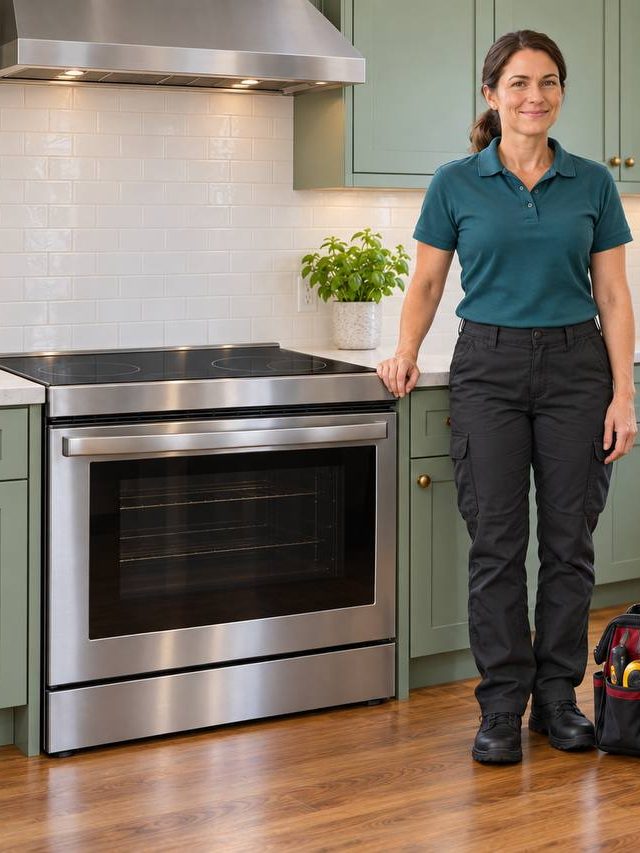
Where Puget Sound Energy runs natural gas through Lacey, gas ranges are common; gas heats roughly 35 to 44 percent of homes across Lacey, Olympia and Tumwater, and houses at the rural edges sometimes cook on propane. Many newer homes in Hawks Prairie and Horizon Pointe carry smooth-top electric or induction ranges instead, or pair a wall oven with a cooktop set into the counter, and older kitchens in Tanglewilde and Thompson Place may cook on either fuel after decades of remodels. Water barely touches a range, except on steam-assist ovens, where harder wells can leave scale in the reservoir. Weather matters more. Fall and winter windstorms cut power, and when it returns with a surge, electronic oven controls, clocks and touch panels can come back scrambled or dark. Turn the knobs off when the lights go out.
Picture a gas range in a Brentwood kitchen where the oven now needs close to an hour to reach temperature and, some evenings, never lights at all. That pattern usually belongs to a weakening glow-bar igniter, which still glows orange but can no longer pull the current the oven safety valve needs before it opens. We begin by asking whether the broiler lights normally, because a working broil igniter narrows the list quickly. Our technician then checks the bake igniter’s current draw with a clamp meter, confirms supply pressure with a manometer, and meters the oven temperature sensor so we do not replace the wrong part. With a new igniter in place, we watch several ignitions, check the flame shape, and run the oven against a separate thermometer to confirm it holds temperature.
Jubilee’s 55-plus homes date from 2004 onward, so many ranges and wall ovens there carry electronic controls now old enough for bake elements, door hinges and touch panels to wear. We check element resistance, the oven sensor and the door seal, and we set clocks and temperature offsets so the oven cooks the way you expect.
For many Panorama residents, the range gets used every day, and small faults matter: a knob that slips, an element stuck on high, a door that drops too fast on worn hinges. We test infinite switches and elements, replace tired hinges, and show how to use the control lock so a bumped touch pad cannot start the oven.
Tanglewilde’s 1960s kitchens have seen ranges come and go, and some have switched between gas and electric along the way. We check that a gas range has a proper shutoff and flexible connector, that an electric range sits on the right cord and outlet, and that the anti-tip bracket is engaged when we slide it back.
Rental kitchens along the College Street corridor near Saint Martin’s University take hard daily use from a changing cast of cooks. Cracked cooktop glass, a burned-out bake element, missing knobs and an oven door that no longer seals are typical. Between tenants, we note every fault on one written price, so the owner sees the whole picture.
When Puget Sound Energy brings the lights back after a windstorm, a surge can leave an oven display dark, blinking or unresponsive. Turn off the range’s breaker, wait sixty seconds, then restore it. When the control stays confused, we test the power supply, the oven sensor and the control’s relays before recommending any board.
A holiday boilover can leave a gas cooktop burner clicking nonstop or refusing to catch. Usually the igniter is wet or crusted, the burner cap sits crooked, or spilled liquid has reached a spark switch. We clean and dry the parts, meter the spark module and each switch, and replace only what fails.
In many electric and dual-fuel ranges in Lacey’s newer homes, the bake element hides under the oven floor, so a failure is easy to miss. When the oven stays cool or bakes unevenly, both elements get a resistance reading, and we check the sensor and look for a scorched terminal before naming the part.
Induction cooktops turn up in newer Hawks Prairie and Horizon Pointe kitchens. When a zone ignores a pan or cuts out, we first confirm the cookware is magnetic and sized right, then check the cooling fan, the zone’s coil connections and the power board, and explain which repairs make sense.
Many cooks run self-clean the week before hosting, and that long high-heat cycle is when door lock motors, thermal fuses and oven sensors most often give out. Let the oven cool fully, and never force the latch. We test the lock assembly and fuse, then release the door safely.
Oven and stove repair in Lacey starts when you call or send the online form; our scheduling desk asks about fuel and appliance type, then confirms an arrival window. Our technician listens first, then tests: element resistance and sensor readings on electric models, igniter draw and supply pressure with a manometer on gas. The failed part gets a name, and the repair gets one price on paper. Say yes, and that price has the $99 inside it rather than as an extra line, while a no ends the day’s charge at $99. Our vans usually carry igniters, elements, sensors and switches. We finish with a heat test against a separate thermometer, a written warranty and a care note on cleaning and self-clean use.
After a holiday meal, wipe cooktop spills once the surface is cool, and use the self-clean cycle sparingly, never in the days right before you host. On gas burners in Lacey kitchens, with everything off and cool, lift the caps now and then and brush crumbs away from the igniters.
When the oven will not heat or a burner will not catch, book a Lacey range visit, and we will have it cooking again with a care note to keep it that way.
Request serviceYes. Induction cooktops, dual-fuel ranges and double wall ovens turn up often in Hawks Prairie, Horizon Pointe and other newer Lacey neighborhoods, and our technicians work on all of them. We test induction coils, cooling fans and power boards, and on dual-fuel models we check both the gas cooktop and the electric oven. Brands include Bosch, GE Profile, Café, KitchenAid, Whirlpool, LG, Samsung, Frigidaire Gallery and Electrolux. Still under the maker’s warranty? Use that coverage first.
Not yet. With a gas smell, leave light switches and appliances exactly as they are, get out of the house, and call Puget Sound Energy or your propane supplier from outside. After the utility has checked the line and called it safe, book with us and our technicians will test the range’s valves, connectors and burners with a manometer and leak solution. Gas work always belongs to trained hands, never a homeowner’s wrench.
Usually, yes. Many wall oven repairs, such as a bake element, sensor, door hinge or door lock, happen with the oven in place. Some control and wiring repairs need the oven slid forward out of the cabinet, and our technicians bring the extra hands and floor protection to do that carefully. We tell you before we start whether removal is needed, and the written price reflects it.
Often it is worth it. Ranges are simpler than most appliances, and a gas or electric range of that age with a failed igniter, element, sensor or switch is usually a sound repair. The picture changes when the oven cavity is rusted through, the cooktop glass is cracked and the control has also failed, or parts are no longer made. We give you one written price and a plain opinion so you can weigh it against replacing.
Your $99 buys the visit plus the testing that finds the fault. A single price for the repair follows, written down. Approve it, and the repair figure has absorbed the $99, so the invoice shows one total. Pass on it, and you pay the $99, keep the findings, and owe nothing more. Either way, the technician leaves a care note on cleaning and self-clean timing.
One $99 visit to track down the fault, then a quote on paper. Go ahead with it and those $99 are tucked inside the total.