Also repaired
The other machines we look after
Tap a photo for that repair page.
Food warming in a fridge whose motor still hums, a garage freezer going soft, puddles gathering beneath the crisper drawers: our team sees all three across Lacey, Olympia and Tumwater, and a warm box gets first claim on same-day openings.
Tap a photo for that repair page.
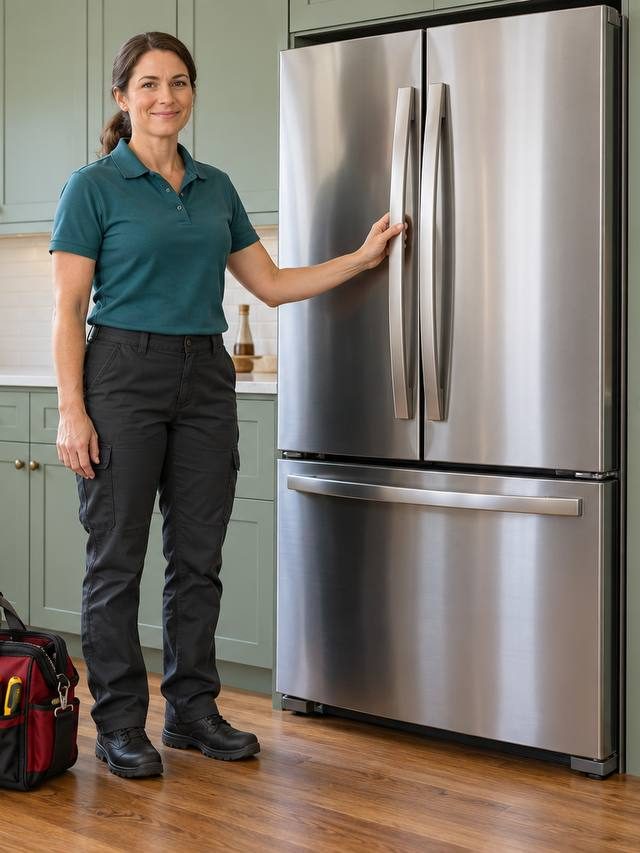
The mild climate around Lacey, Olympia and Tumwater still leans on a refrigerator in quieter ways. Through the long wet season the air stays heavy with moisture, which loads door gaskets and evaporator coils, so a tired defrost heater shows itself sooner here. Garage freezers ride out close to 78 nights below freezing in a typical year, and a combination unit in an unheated garage can quit cycling once its thermostat mistakes the chill for a job done. Summers are kind until they are not; in June 2021 the airport thermometer touched 110, and dusty coils could not keep pace. Fall windstorms, like the one at the end of September 2026 that darkened much of the county south of Olympia, leave compressors and controls restarting on shaky current.
Food going soft moves a call up the day’s list whenever there is room, and once we arrive the first tool out is a thermometer in each compartment, to see how far temperatures have wandered. Then we listen. A compressor clicking on and off, an evaporator fan gone quiet, or a condenser fan humming without turning each points a different way. We look over the condenser coil for dust and pet hair, take down the freezer’s back panel when frost has built up in a telling pattern, and meter the fan motors and each defrost part. All that comes before any mention of the sealed system, since most warm refrigerators have a fan, defrost or airflow fault our technicians can fix, often from stock we carry.
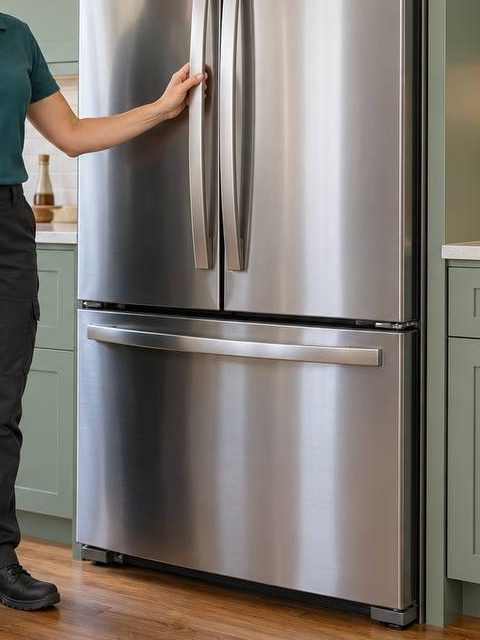
Our technicians work on refrigerators of every common layout: freezer on top or below, side-by-side doors, French doors over a pull-out drawer, counter-depth units in newer townhomes, and built-in column or panel-ready models. Standalone freezers are part of the job too, upright or chest, including the ones kept in garages and sheds. Makers we see often include GE, Whirlpool, LG, Frigidaire, Frigidaire Gallery, KitchenAid, Maytag, GE Profile, Café, Kenmore, Bosch, Electrolux and Amana. Ice makers and door dispensers have a page of their own, though we check them on the same visit. Our company stands apart from every manufacturer, so when the maker’s coverage still applies to your refrigerator, we point you there first.
When the freezer holds but the lower shelves warm, chilled air has stopped crossing into the refrigerator section. Usual suspects: a stalled evaporator fan, a stuck damper door, or a coil packed in ice after a defrost part quit. We press the door switch to see whether the fan spins, study where the frost sits and meter the heater and its thermostat.
A thick white layer behind the freezer panel, or frost pushing out through the vents, points to a defrost system that has stopped cycling. The defrost heater, its bimetal thermostat and the defrost timer or control each play a part. We thaw enough of the coil to reach the parts, meter each one, and check the drain beneath the coil for ice.
Puddles below the crispers, or ice glazing the floor of the fresh food section, usually trace back to a defrost drain that is blocked or frozen shut. Meltwater meant for the pan spills inside, and our damp months make that more likely. We flush the drain line, look at its heater or metal clip, and work out why the ice formed.
A short click, then quiet, repeating every few minutes, usually means the compressor keeps attempting to start while the start relay or overload shuts it down. The surge when a windstorm outage ends can finish off a tired relay. Our technicians test that relay, read the compressor windings, make sure the condenser fan spins, and say in plain terms whether the compressor has failed.
A freezer side that goes soft on the coldest nights usually belongs to a combination refrigerator-freezer in a garage with no heat. Once that air nears freezing, the fresh food thermostat stops asking for cold, and the freezer drifts warmer with it. We look up the model’s rated room range, test the controls and discuss whether a standalone freezer suits that space.
Beads of water along the door edge, or frost near the gasket inside, mean warm, damp kitchen air is getting in. A torn or flattened gasket, a door sagging under a heavy load of bottles, or a cabinet that is not level will all do it. We run a paper-strip test around the door, level the cabinet, then adjust the hinges or replace the gasket.
| Part | What goes wrong | How we confirm it |
|---|---|---|
| Evaporator fan motor | Bearings seize, so the freezer stays cold while fresh food warms | Spin check and a voltage reading with the door switch held |
| Defrost heater and thermostat | The heater burns open and the evaporator coil ices solid | Resistance and continuity readings once the coil is exposed |
| Condenser coil and fan | Dust and pet hair choke airflow and the compressor runs hot | Visual check, fan spin test and a temperature reading across the coil |
| Compressor start relay | Fails after surges, so the compressor clicks without starting | Relay meter test and a listen for a clean compressor start |
| Refrigerator door gasket and hinges | The seal tears or flattens, letting damp air frost the cabinet | Paper-strip test around each door and a hinge alignment check |
| Fresh food thermistor and control | False readings leave the box too warm or freeze the lettuce | Thermistor resistance compared with thermometer readings in each compartment |
With refrigerators the dividing line is the sealed system. Fans, defrost parts, relays, thermistors, gaskets and controls are all replaceable, and a refrigerator with one of those faults is usually worth repairing even past its tenth year. A failed compressor, a refrigerant leak in the evaporator or a cracked inner liner is a different conversation, especially on an older model with a tired cabinet. We tell you which side of that line your refrigerator sits on, and what a new unit would and would not solve. The food counts too: with a chest of smoked fish and picked blackberries at stake, a repair that holds for years often beats waiting on a delivery date. The written price and the decision are both yours to weigh.
When a refrigerator or freezer starts warming, ask our scheduling desk for the earliest opening. Approve the fix and the $99 lives within its total; decline, and you owe the $99 alone.
Request serviceWhen food is at risk, our scheduling desk looks for an opening that same day and books the earliest one the schedule holds. Tell them the unit is warm, what a thermometer shows if you have one, and whether the freezer is slipping as well. Until we get there, open the doors as little as possible and pack milk, meat and leftovers into a cooler on ice. Pull the plug only if you smell something hot.
Not always. After an outage a refrigerator can need several hours of steady current to pull its temperatures back down, and some electronic controls want a reset: cut power at the plug or the breaker, wait five minutes, then restore it. If the compressor and fans are running but nothing has budged after half a day, or you hear clicking with no hum, a surge may have hurt a relay, fan or control, and our technicians should test it.
Yes. Freezers kept in garages and outbuildings, chest or upright, are steady work for our team in Tumwater, Olympia and Lacey, as are refrigerator-freezers that were never built for an unheated room. We test the temperature control, the defrost system on no-frost uprights, the door seal and the condenser, and we check whether the model’s rated range suits that garage on our freezing winter nights.
Our technician reads the temperatures, tests the fans, defrost parts and controls, then names the fault and writes a price. Accept the repair and that $99 already sits within the quoted figure instead of appearing as another line. Choose a new refrigerator instead, and the $99 pays for the visit in full; you leave with a diagnosis you can take along when you shop.
If a part needs ordering, we explain how to protect your food in the meantime. Where the evaporator coil has iced over, a manual defrost, with the refrigerator unplugged, doors open and towels on the floor, often brings back cooling for several days. The trip back to install it is not billed as a new call, and the warranty on your invoice covers the finished work.
Warm cabinet sides are normal on many models, because a loop of refrigerant tubing runs behind the side panels to keep them from sweating. Constant running is different: it usually means a dusty condenser coil, a failing condenser fan, a leaky door gasket or a room that is simply too hot. Clean the coil with the power off, check the seal, and call us if temperatures keep drifting upward.
Phone or the form. Mention the brand and what the machine is doing; our scheduling desk sets an arrival window.
Meter, thermometer, fill and drain timing, a manometer on gas lines. Then we tell you which part quit, in everyday words.
The full repair on paper before a screw turns. Our $99 visit is tucked into that number if you go ahead.
A test run, a tidy floor, warranty terms on the invoice and a short note on what to clean and when.
Book the $99 visit. Okay the written quote and it absorbs the $99; pass on it and $99 covers the whole call.