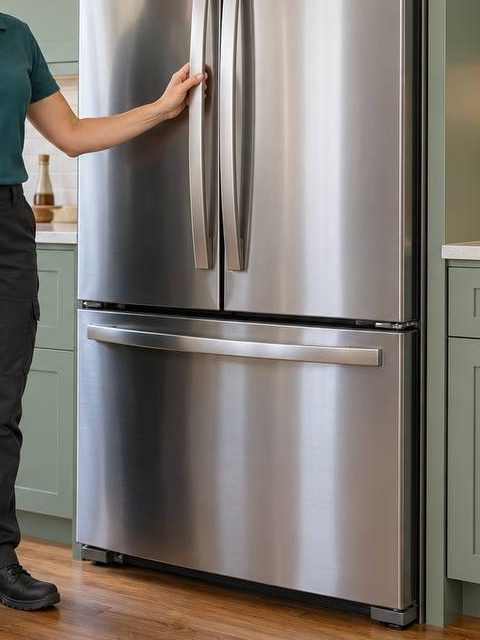
Why outages hit appliances here

Fall and winter windstorms bring down firs and power lines across Thurston County, and an outage can last from an evening to several days. The windstorm of late September 2026 darkened tens of thousands of Puget Sound Energy accounts, with the heaviest losses south of Olympia. Garage freezers packed with fish, berries and bulk meat are common here, and they hold a lot of value through a long outage. Homes on private wells lose running water along with the lights, which leaves ice makers and washers dry. When crews restore a line, a surge or a string of flickers can follow, and electronic controls do not always take that well.
The repairs that follow an outage fall into two groups. The first comes from the power itself: a surge or a run of brownouts as service returns can knock out a refrigerator control board, a compressor start relay or an electronic range control, and owners see the light on but no cooling, or a blank display. The second comes from what happened while the power was off: frost that melted and refroze into a solid block around the defrost drain or the ice maker, a garage freezer that restarted with its door slightly ajar, or a washer that sat full of water mid-cycle and began to smell. Much of the food loss is avoidable with a thermometer and patience.
What to do during and after
- 01Keep doors shut, thermometers inside
Once the lights go out, open the refrigerator and freezer as little as possible. With the doors kept shut, the fresh-food side stays cold enough for roughly four hours; a packed freezer lasts about 48, and one only half full, about 24. Set an appliance thermometer mid-shelf in each so you can read the real temperature later instead of guessing.
- 02Switch off appliances until power steadies
Turn off or unplug the range, dishwasher, washer and dryer, and consider unplugging the refrigerator and freezer too, so the surge and flickers of restoration never reach their controls. Leave one lamp switched on so you know the moment service returns.
- 03Restore power one machine at a time
Once power has held steady for several minutes, plug in or switch on the refrigerator and freezer first. Many refrigerators wait a few minutes before the compressor starts, and a full cooldown can take most of a day. Then bring the other appliances back one at a time rather than all at once.
- 04Sort the food by temperature
Read the thermometers. Meat, dairy, cooked leftovers, cut produce and other chilled perishables go in the trash once they have spent over two hours above 40°F. Freezer items still carrying ice crystals, or reading 40°F or colder, are safe to refreeze, though texture may suffer. When in doubt, throw it out.
- 05Clear the ice and look for water
Empty the ice bin, since cubes that melted and refroze clump together and can jam the auger. Check under the crisper drawers and along the freezer floor for melted frost, and dry it. Look under the dishwasher and washer for leaks from a cycle that stopped mid-fill.
- 06Reset clocks and finish stalled cycles
Set the range clock, because some ovens will not bake until the time is set. Restart any washer or dishwasher cycle that stopped with water inside, or run drain and spin so the water does not sit. On a private well, let the pump rebuild pressure before starting anything that fills.
Keep these ready for storm season
- An appliance thermometer for each refrigerator and freezer
- A cooler with gel packs or block ice
- Towels for melt water
- A flashlight rather than candles in the kitchen
- A written list of what is in the garage freezer
When the outage left damage behind
Call our team if the refrigerator or freezer has power again but is still warm after several hours, if the compressor clicks on and off without running, or if the display stays blank or flickers. The same goes for a range whose clock and controls stay dead after the breaker checks out, and a washer or dishwasher that will not start or drain. Those usually mean a control board, relay or fuse took the surge, and control boards and live wiring are ours to test. Do not keep resetting a breaker that trips again; a repeat trip is a sign of a real fault.
Storm outages in Lacey, Olympia and Tumwater
The late-September 2026 windstorm hit hardest south of Olympia, in Tumwater and the county’s rural stretches, where well pumps stop along with the lights and propane homes lose the fans and controls that run their appliances. Lacey’s newer subdivisions and Olympia’s older neighborhoods lose power to the same winds. Tell us the box has gone warm; a thawing freezer or a warm refrigerator jumps ahead in our queue, and we fit in a same-day visit whenever the calendar has room. Approving the repair makes the $99 visit part of the written price; turning it down means the $99 is all you pay.
A thermometer and a closed door save more food than any gadget during a Thurston County outage. If a refrigerator, freezer or range comes back from the storm acting strangely, our team will test it and name the part that failed.
Request serviceQuestions on this care note
With the power out, how many hours is my refrigerator food safe?
Roughly four hours, provided nobody opens the door. Freezers last longer when left shut: close to 48 hours packed full, about 24 when half empty. Once power returns, judge each item on its own. Toss chilled perishables that spent over two hours above 40°F; frozen food that still shows ice crystals, or reads 40°F or colder, can return to the freezer.
Can I run my refrigerator on a portable generator?
Yes, with care. Keep the generator outdoors and well away from doors, windows and vents, and connect the refrigerator with a heavy-duty outdoor extension cord rated for the load. Never back-feed a generator through a dryer or range outlet; it can energize the utility line and endanger line crews. A transfer switch installed by an electrician is the safe way to power house circuits.
Why is my refrigerator running but not cooling after the power came back?
Give it several hours first; a warm refrigerator needs time to pull down, and many wait a few minutes before the compressor starts. Should the fresh-food compartment still read above 40°F six or so hours later, or the compressor never kick on, the surge may have damaged the control board, start relay or a fan motor. Let our scheduling desk know the food is warming, and a same-day opening goes to you if one exists.
Should I unplug appliances when the power goes out in a storm?
It helps. Unplugging or switching off the dishwasher, washer, dryer and range keeps the surge and flickers of restoration away from their electronics. The refrigerator and freezer can be unplugged too, as long as someone remembers to plug them back in once power holds. For homes that lose power often, a whole-house surge protector installed by an electrician adds another layer.