Olympia · more repairs
A refrigerator that hums but won’t cool, or a garage freezer found soft after a windstorm, moves up our Olympia schedule.
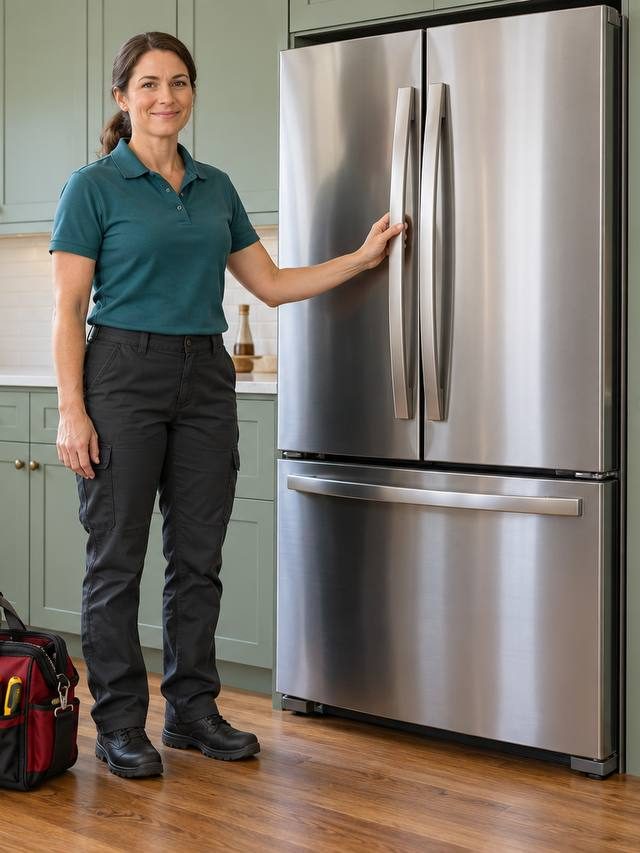
Refrigerators in Olympia work in a wider range of rooms than most owners expect. About half the city’s homes were built before 1980, so many kitchens have alcoves framed for a shorter, narrower box, and the wide French-door models sold now get squeezed into them with barely any breathing room at the condenser. Out in attached garages, a spare refrigerator or chest freezer sits through close to 78 frosty nights each year, plus the odd scorcher like June 2021, when the gauge at the Olympia airport climbed to 110°F. Fall and winter windstorms cut PSE power often enough that start relays, compressors and controls take a jolt when service returns. The soft city water is gentle on dispenser valves and filters, so most Olympia cooling trouble traces to airflow, defrost parts and electrical components rather than mineral scale.
Here is a typical Olympia call from October: the freezer of a GE side-by-side in an Eastside kitchen still holds ice cream, but the fresh-food side reads 50 degrees and the milk has turned. Because food is warming, our scheduling desk moves the call up when a same-day slot is open. Our technician first sets a thermometer in every compartment, then listens at the evaporator cover. A silent evaporator fan, or a coil packed with frost behind the panel, says the defrost system has stalled, something damp fall air makes more likely. Next the fan motor gets metered, along with the defrost circuit’s heater and thermostat, and we make sure ice hasn’t sealed the drain. We tell you which piece quit and write the repair cost down ahead of any work; most of those parts already travel on our vans.
Many Eastside homes are older, and their kitchens often hold the refrigerator in a snug alcove beside a doorway. Tight clearance traps heat around the condenser, so compressors run long and fans wear early. We check airflow at the grille and the back, test the condenser fan motor and look at the coil for dust and pet hair.
Forest Hills and Holiday Hills houses, mostly from the 1950s to 1970s, often have attached garages holding a second refrigerator or chest freezer. On cold nights a garage fridge’s freezer section can soften, because the chilly room satisfies the fresh-food side and the compressor idles; on hot days the condenser struggles. We weigh placement, coils and defrost parts together.
Cooper Point kitchens often hold French-door or built-in-style refrigerators from GE Profile, Café, KitchenAid or Whirlpool, with dispensers, drawers and several fans. More fans and sensors mean more places for a single weak part to warm one section while the rest seems fine. We check each compartment with a thermometer and test dampers, fans and sensors in turn.
Houses out toward Boston Harbor sit among tall firs on the county’s rural edge, where a windstorm can leave a garage freezer without power for a stretch. When the lights come back, we test the start relay, compressor windings and control. If your house draws from a private well, we also check the dispenser line and inlet screen for sediment.
Heat trapped in a narrow alcove makes the condenser fan and compressor work harder, and a weak fan or dusty coil tips the balance toward a warm fresh-food section. We measure temperatures, test the condenser fan and start relay, clean the coil, and tell you how much side and top clearance the model needs.
A refrigerator-freezer in an unheated garage can let its freezer warm on cold nights, because the fresh-food thermostat rarely calls for cooling. We check whether the model suits garage use, test the thermostat and defrost parts, and suggest placement changes, or a standalone freezer, when that is the real fix.
If you hear a click, then quiet, then another click a few minutes on, the compressor is attempting to start and giving up. After an Olympia outage and its restoration surge, we check the overload, the start relay and, with a meter, the compressor windings; sometimes a control reset is the whole fix.
Olympia air stays damp most of the year, so each door opening adds frost to the evaporator. Once the drain clogs or a defrost part quits, ice seals the coil, air stops moving and the fresh-food section loses its chill first. We meter the defrost circuit, clear the drain and replace whatever failed.
Beads of water on the door edges or inside the fresh-food section usually trace to a tired gasket, a door out of level or, on French-door models, a dead mullion heater. Fall fog makes it show sooner. We check the seal with a paper test, adjust the hinges and test the heater.
Tell our scheduling desk, by phone or online form, how warm the food is; a warming refrigerator or freezer gets pulled forward to that day whenever a gap allows. At your Olympia home, our technician hears the story, reads each compartment’s temperature, meters fans, relays and defrost parts, and inspects coils and gaskets. We point to the part that let go, in everyday words, and quote one written figure. Coming out costs $99. Approve the fix and that amount lands within the repair bill rather than on top of it; wait, and the $99 is your whole cost. Fans and relays usually travel on our vans, and a part we have to order gets fitted on a second stop that carries no trip charge.
Twice a year, unplug the refrigerator and vacuum the condenser coil and fan through the lower grille or back panel. In Olympia’s damp air, also wipe the door gaskets with warm, soapy water so mildew and grime don’t keep them from sealing against the cabinet.
If the refrigerator in your Olympia kitchen or garage is warming, tell our scheduling desk how warm, and we will move as quickly as the day allows. Approve the fix and that $99 counts as part of its price; pass, and you have paid for the visit alone.
Request serviceOften, with some care. On cold nights some refrigerator-freezers let the freezer warm because the fresh-food thermostat stops calling for cooling, and in a rare heat wave the condenser struggles. Check the manual for a garage rating and leave room for air around the cabinet. If frozen food is softening, our technicians can check the thermostat, defrost heater and sensor and tell you whether placement is the real issue.
The worst of the late-September storm landed in the county south of Olympia, yet even a brief blackout in town can scramble a refrigerator’s control when the power snaps back. First check the breaker, then leave the unit unplugged briefly before restoring power, which resets many controls. If it still isn’t cooling by later that day, a start relay, control or fan may have failed in the surge. We test those and tell you which one.
Yes. Built-in-style models are regular work for us, alongside top-freezer, bottom-freezer, side-by-side and French-door refrigerators from GE, GE Profile, Café, KitchenAid, Whirlpool, Maytag, LG, Bosch, Frigidaire, Electrolux, Kenmore and Amana. Those carry more fans, dampers and sensors, so we test each compartment separately. Still inside the maker’s warranty period? Start there, since we are an independent company tied to no brand.
Tell our scheduling desk the food is warming, and your call moves toward a same-day slot when there is room that day. Meanwhile, keep both doors closed, move the most important items into coolers with ice, and don’t load warm food into the freezer. A packed freezer stays cold far longer than a sparse one. When our technician arrives, the thermometer and meter tests come first, then a written price.
Look first at two things, the failed part and the cabinet’s condition. A fan motor, defrost part, start relay or door gasket on an older refrigerator is usually worth replacing, above all when the unit fits an alcove that newer models don’t. On an aging unit, a dead compressor or leaking refrigerant is a different story, and repair gets harder to justify. We lay out both paths plainly, with a written price, and the choice stays yours.
One $99 visit to track down the fault, then a quote on paper. Go ahead with it and those $99 are tucked inside the total.