Why the filter and water line matter here
Every cube your ice maker drops begins at the household supply line, passes an inlet screen at the fill valve, runs through the filter cartridge and lands in the mold through a short fill tube. Lacey’s water comes from roughly 20 city wells, and in some of them iron and manganese run a touch high, enough to streak a sink orange or brown. Out in unincorporated Thurston County, private wells can hold even more. That sediment loads a filter faster than the calendar suggests. Olympia’s soft water is easier on the parts, yet an old cartridge still slows the flow, and the ice maker then fills its mold short, which shows up as small, hollow or clumped cubes.
When the filter goes unchanged, flow drops and the ice maker starts to misbehave. A slow trickle into the fill tube can freeze before it reaches the mold, so the tube plugs with ice and production stops. Sediment that gets past a spent filter clogs the fill valve’s inlet screen or keeps its seat from closing, which causes a drip that builds an ice dam in the bin. Stale water tastes flat and makes cloudy cubes. These are among the quickest calls our team runs: a fill valve, a frozen fill tube, an ice maker module or a door-dispenser part, usually carried on the van and changed in one visit.
Changing the filter and refreshing the ice
- 01Match the filter to the model
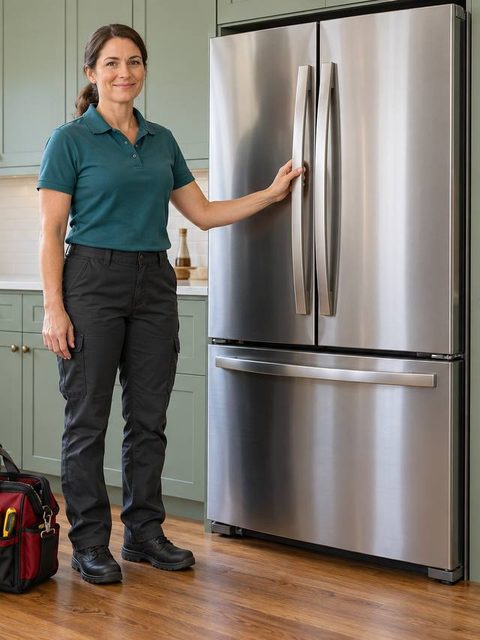
Open the refrigerator and find the filter housing, often in an upper corner of the fresh-food section, in the base grille or behind a small cover. Write down the part number printed on the old cartridge and check it against the model number on the label inside the compartment before buying a replacement.
- 02Pause the ice maker, then unplug
Turn the ice maker off with its switch or by lifting the wire arm, whichever your model uses. Pull the refrigerator’s plug or flip its breaker off for the few minutes this job takes; the food will stay cold if the doors stay shut. Fold a towel under the filter housing.
- 03Swap the cartridge
Turn the old cartridge a quarter turn counterclockwise, or press the release button, and draw it straight out. Remove the cap from the new one, line up its arrow, push it in and turn until it seats firmly. A slight click or a firm stop tells you it has locked. Wipe any drips.
- 04Empty and wash the ice bin
Lift out the bin, dump the old ice in the sink and wash the bin in mild, soapy water. Rinse well and dry it completely before it goes back, since water left in the bin freezes the new cubes into a block. Clear any chunks stuck on the auger.
- 05Flush the new cartridge
Restore power, hold a large pitcher under the door dispenser and run water in short bursts until it flows clear and steady, usually a few gallons; your manual gives the exact amount. The first water may sputter or look gray from trapped air and carbon dust, which is normal.
- 06Restart and toss early batches
Turn the ice maker back on. Throw out the first two or three batches of ice, which can carry carbon fines or an off taste. Reset the filter indicator light if your refrigerator has one, then write the date on a strip of tape inside the door so the next change is easy to track.
What the job takes
- The replacement cartridge matched to your model number
- A towel for the filter housing
- A large pitcher or bucket
- Dish soap for the ice bin
- Masking tape and a marker for the date
When it is more than a filter
If a fresh filter and a full flush still leave the ice maker idle, or water trickles weakly from the dispenser, the trouble usually sits past the cartridge. Call us when you spot a plug of ice lodged in the rear fill tube, water under the refrigerator, a dispenser that clicks without flowing, or an ice maker that fills but never ejects. The fill valve and the wiring behind the cabinet carry water and line voltage side by side, so our technicians test them with the power handled correctly. If the supply connection at the wall drips, close its valve and leave the fittings to us.
Ice and water in Lacey, Olympia and Tumwater
If your home draws from one of Lacey’s iron-bearing wells or a private well near the county’s rural edge, the six-month filter may need changing sooner; a brown tint in the first cup or orange staining on the dispenser tray is your cue. Tumwater’s water sits between soft and moderate and Olympia’s is soft, so cartridges there usually last the full term. Ice maker calls tend to be quick visits for our technicians. We charge $99 to diagnose it. Give the nod and that amount is built into the repair price; decide against the repair, and that diagnostic visit is the one line on your invoice.
Date the cartridge, flush it well and the ice keeps coming clear and full-sized. When it stops anyway, fill valves and ice maker modules are usually quick fixes for our team.
Request serviceQuestions on this care note
How often should I change my refrigerator water filter?
About every six months is the usual interval, and many refrigerators light an indicator on that schedule. Change it sooner if the cubes shrink, the dispenser slows or the water picks up an off taste. Homes on iron-bearing wells may need a new cartridge before the light comes on, because sediment loads the filter faster than daily use alone would.
What makes the cubes from my ice maker come out small or hollow?
Short fills are the usual cause. A clogged filter, a partly closed supply valve, low household water pressure or a weakening fill valve all cut the water reaching the mold, so the cubes freeze thin or hollow. Start with a new filter and make sure the supply valve is fully open. If cubes stay small, our technician tests the fill valve and the water pressure at the refrigerator.
Can I run the refrigerator without a water filter?
Some models accept a plug in place of the cartridge, and others will not dispense at all with the housing empty. Running without one sends any sediment in the supply straight to the fill valve and ice maker, which matters around Lacey’s iron-bearing wells and rural private wells. We suggest a cartridge matched to your model and changed on schedule instead.
Why does water from a new filter taste strange?
A new carbon cartridge sheds fine black dust and trapped air until it has been flushed, and the first ice can carry that taste too. Run several gallons through the dispenser in short bursts and discard the first batches of ice. If the taste lingers after a day, confirm the cartridge matches your model and is seated fully in its housing.